
Four R&D concepts, budget for one: the internal favorite had the weakest demand
You probably have a favorite R&D concept. Is it the market's favorite too?
- Case Study - Demand Validation
- Polymer additive applications
EXECUTIVE SUMMARY
Who
Solution
SpecialChem's Demand Validation: an unbranded concept test with formulators, compounders, and materials specialists in Europe, North America, and Asia.
Challenge
Four early-stage R&D concepts, budget to develop one, and no market evidence to choose.
Result (5 months)
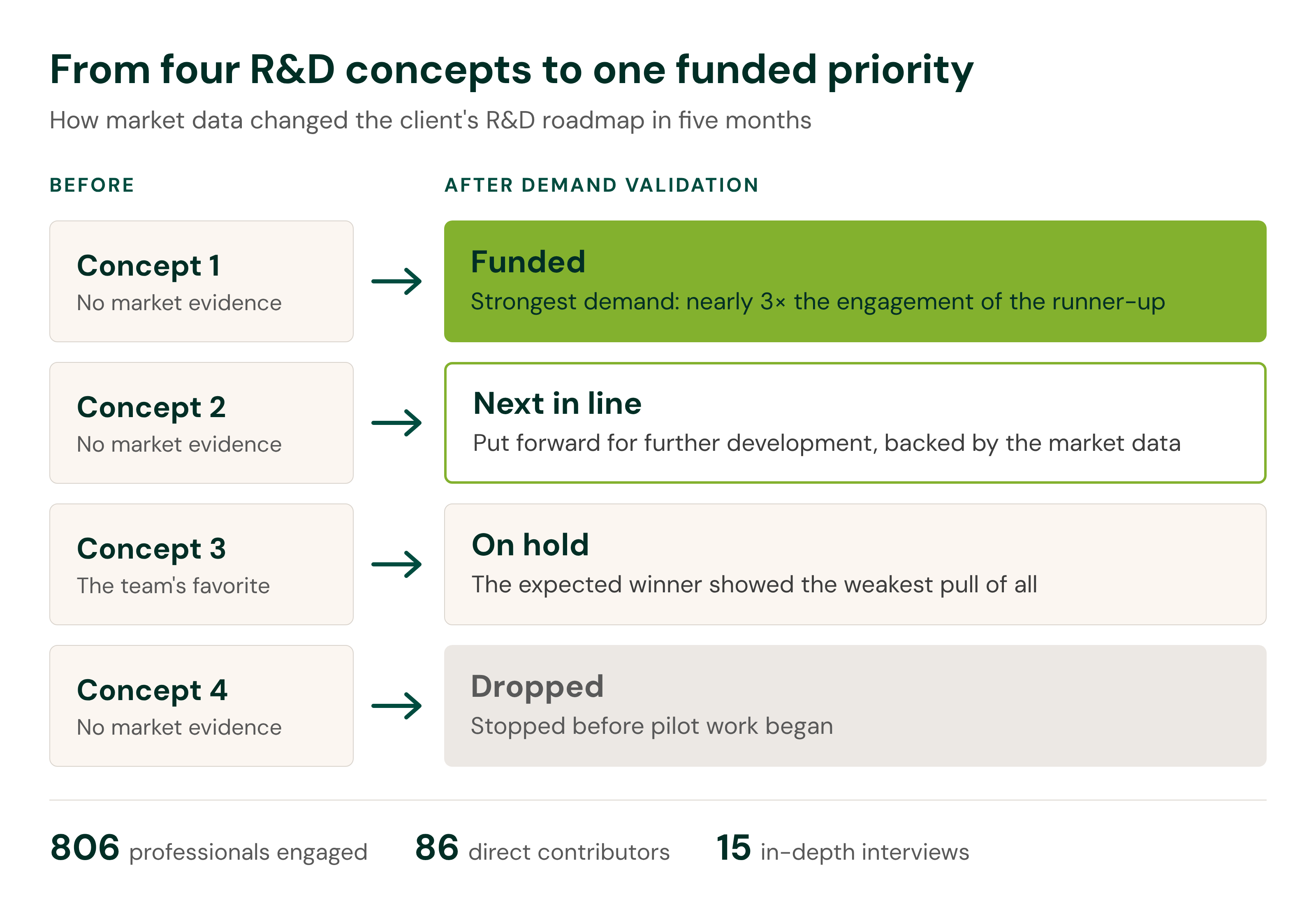
At least two years of full-time R&D effort saved. One concept funded, a second in line, the original favorite on hold, one dropped before pilot work.
Who
Challenge
Four early-stage R&D concepts, budget to develop one, and no market evidence to choose.
Solution
SpecialChem's Demand Validation: an unbranded concept test with formulators, compounders, and materials specialists in Europe, North America, and Asia.
Result (5 months)
At least two years of full-time R&D effort saved. One concept funded, a second in line, the original favorite on hold, one dropped before pilot work.
About the client
The client's innovation team had four R&D concepts in the pipeline and the budget to develop one. Each concept was technically sound. The team also had a favorite: one application segment looked like the most likely winner. What they did not have was market evidence to back that choice, or to rank the other three.
Why should suppliers test market demand before investing in R&D?
The technology wasn't in question. Demand was. Which concept would the market actually pull?
A new additive can take years of development and customer qualification before it earns anything. That's a long time to spend on a concept nobody asked for. With budget for only one concept, a wrong pick meant losing years of R&D.
How do you test demand for a new additive before it's even developed?
Starting from the client's lab results, SpecialChem's Demand Validation team built an unbranded concept test on the SpecialChem platform. It put today's solutions next to the four possible future options and let the market compare.
We promoted it to formulators, compounders and materials specialists across Europe, North America and Asia. Because the test was unbranded, people reacted to the technology and not to the supplier's name.
Anyone interested could answer a few quick questions: What do you use today? Where does it fall short? What do you think of the new materials? We also checked who the interest was coming from: their job, their industry, their region, and the concepts they spent the most time on.
We then called the most engaged respondents for one-on-one interviews, to hear what a form can't capture: what would make them switch, and what would hold them back.
People involved
- Client: Two representatives (R&D and marketing) who provided the initial inputs and ultimately validated the concept.
- SpecialChem: Demand Validation team who managed the project end-to-end, from concept positioning and market testing through interviews, analysis and final recommendations.
|
Phase |
Activities |
|
Month 1 |
Technical review, concept positioning and market-test preparation by the SpecialChem team |
|
Months 2–5 |
Publication, promotion, market engagement, questionnaires, respondent qualification and one-to-one interviews running in parallel. Findings were continuously integrated into subsequent promotion and interview activities to deepen learning and validate emerging insights. |
|
Month 5 |
Final analysis, opportunity ranking, recommendations and report delivery to support R&D prioritization. |
Market engagement
| Stage | Count | What it revealed |
| Professionals engaged | 806 | Which concepts, geographies and applications drew interest |
| Direct contributors | 86 | Application needs, performance benchmarks, adoption barriers |
| In-depth interviews | 15 | Purchase drivers, qualification hurdles, what it would take to switch |
| About two-thirds of contributors worked in R&D, formulation, product development or material selection. They're the people who decide whether a new additive gets trialed. |
Influence of market data on the R&D roadmap
| One concept pulled clearly ahead, with nearly three times the engagement of the runner-up. |
| Most of that interest came from one application segment, where users had a performance gap that current solutions weren't closing. |
| The segment expected to be the most likely winner showed the weakest pull of all. |
| Interviewees kept saying the same thing. What they use today works well enough, and the benefits on offer weren't worth going through a new qualification cycle. |
That changed the plan. Development shifted toward applications where users had sharper technical problems and were more willing to test something new.
What they did next:
-
Invested resources in one concept, aimed at the application with the strongest demand
-
Put a second concept forward for further development, on the strength of the market data
-
Put the team's original favorite on hold
-
Dropped one concept before pilot work began
Result: at least two years of full-time R&D effort saved.
This project was the first of four. The client went on to run three more Demand Validation programs with us.
Not sure which R&D concept to back next?
Test your concepts with the people who would use them, before you commit development budget or when a launch isn't getting the pull you expected.
See how Demand Validation shows where real demand sits for your R&D concepts