
The case study template that worked three years ago is now working against you. AI systems increasingly answer a prospect's search directly. They extract and cite whatever proof they find on a page rather than reading it from start to finish. Human specifiers move just as fast. Revisiting the template
isn't optional anymore.
A case study exists to do one job: position your specific solution as the answer to a defined problem.
Even if you can claim the same benefit in automotive and appliances, for example, produce two distinct case studies. Inside a structured Demand Creation program at SpecialChem, along with banners and outreach campaigns, it helps your products make their entry into a specifier's mental map of solutions.
Yet, the format has changed over the past three years. On top of human readers, you now have a new reader: AI systems answering a prospect's search. It now calls for less narrative, more evidence, shorter pages, and more visuals. A prospect deciding whether to trust a supplier now skims in under a minute, and a case study written as a five-page success story loses that reader before the proof ever arrives. Here are the best practices to keep in mind when producing your next case study.
|
Outline 1. The seven-part structure that gets read in 2026 |
Seven-part structure: how case studies get read in 2026
Think of the structure as an inverted pyramid: the most important proof at the top, supporting detail
below it for the reader who wants more.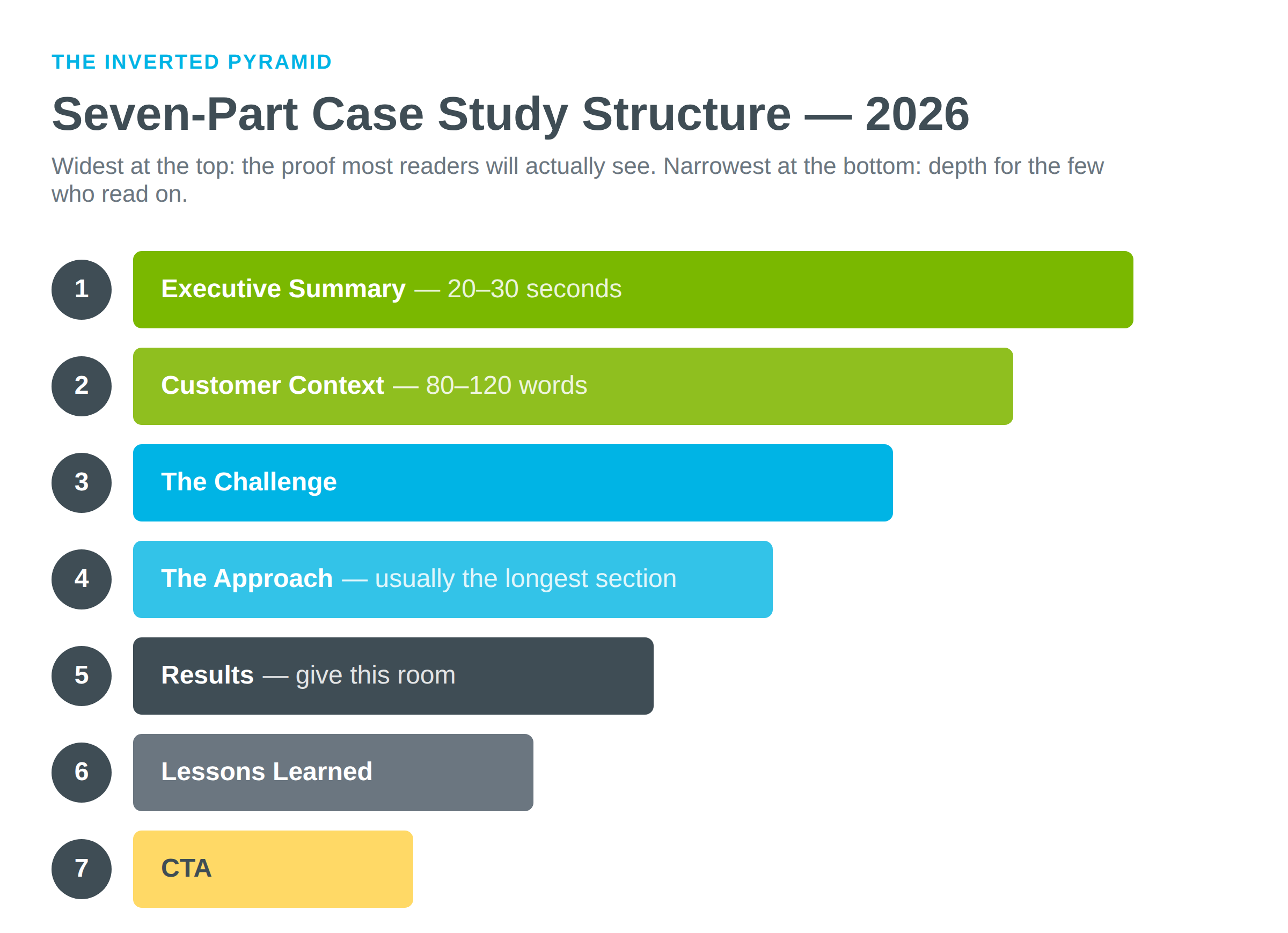
-
Executive summary (20–30 seconds).
This is the section almost every reader sees, so put the whole story in four data points: customer, challenge, solution, result.
For example: a formulator was seeing delamination on 15% of test panels within 48 hours in a 2K waterborne epoxy coating for concrete flooring. A new silane-based adhesion promoter was evaluated across three formulation trials over 10 weeks. Delamination dropped to under 2% of panels, cure time held at 16 hours, and the product cleared the customer's qualification trial before the next flooring season.
A reader who stops here should already have what they need.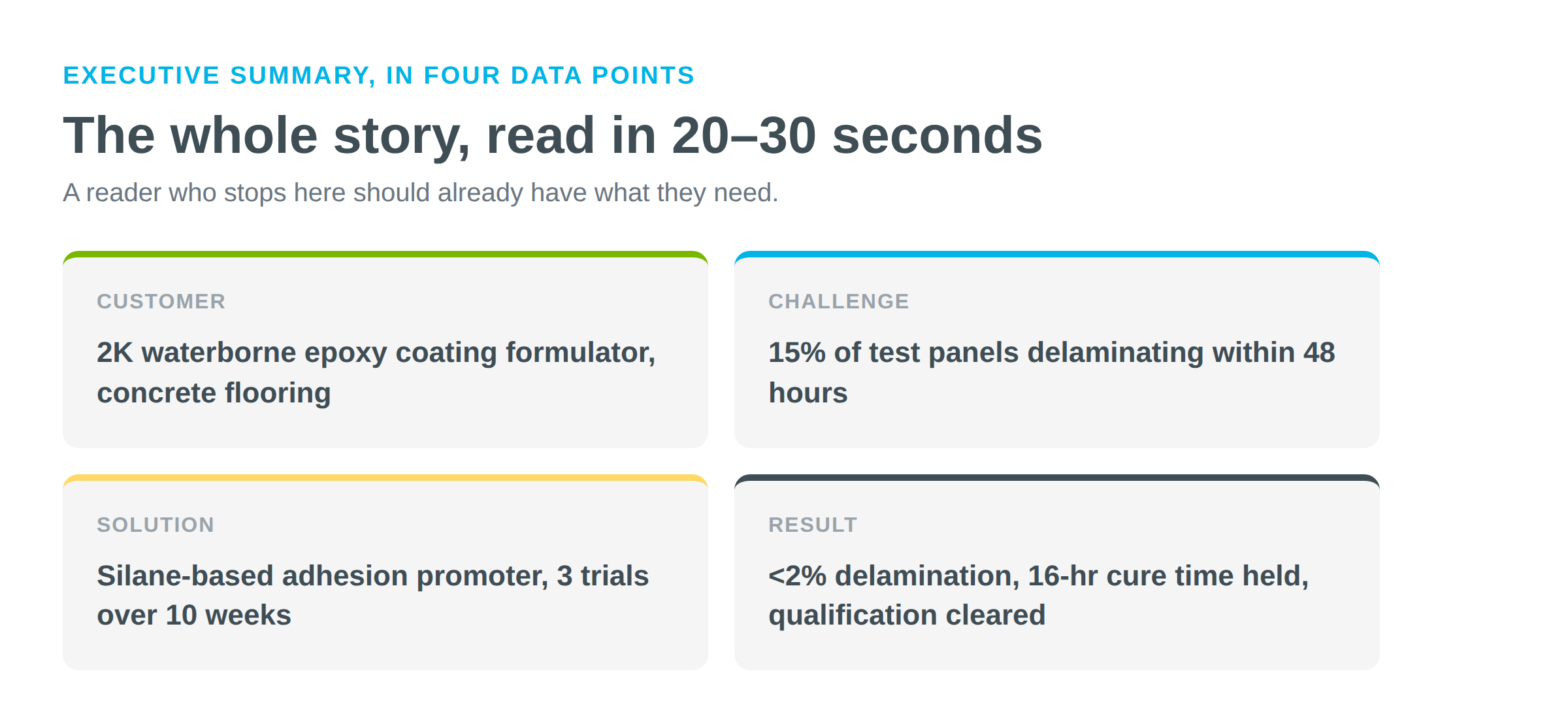
- Customer context (80–120 words).
- The Challenge.
- The Approach.
- Results.
- Lessons learned.
- CTA.
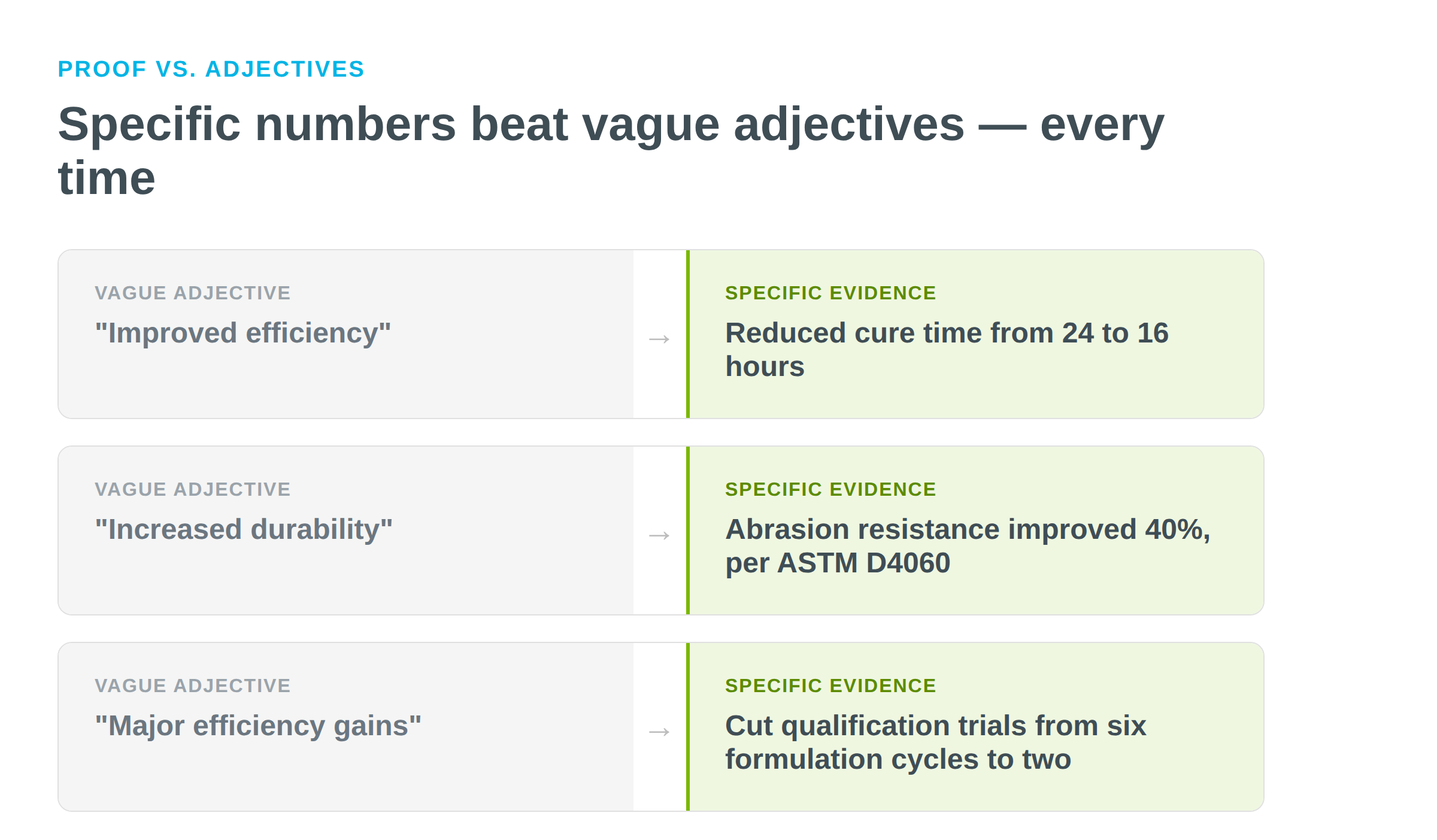
Specific numbers beat vague adjectives every time
Specific numbers beat vague adjectives because a reader can verify a number, but not an adjective.
The comparison below shows the pattern:
Worried your results aren't dramatic enough to headline? A small, verifiable number still outperforms a
bigger, vague one, even when the vague version sounds more impressive.
Visuals now carry more proof than paragraphs do
Replace descriptive claims with a labeled visual wherever the comparison is numeric or sequential.
Instead of writing "we improved adhesion significantly," show a labeled comparison with the number attached directly: delamination rate before the promoter against delamination rate after, with a callout showing the drop from 15% to under 2%. A simple sequence, such as diagnosis, strategy, implementation, and measurement, communicates a timeline faster than a paragraph describing the same four steps in order.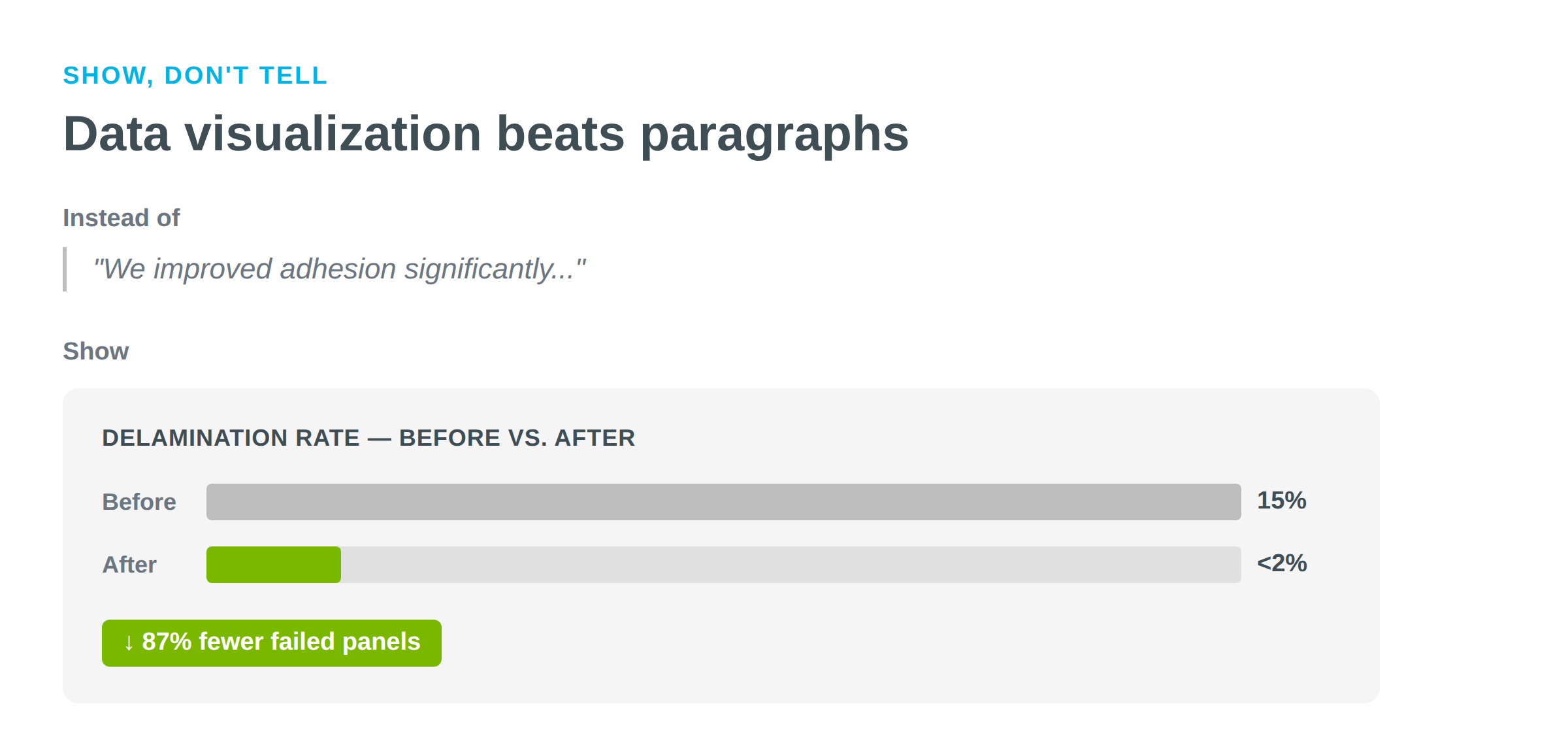
What length is ideal for a case study?
There's no single right length anymore. Suppliers increasingly publish several versions of the same case study: a one-page executive summary, a fuller web page, a downloadable PDF for a sales conversation. Web pages have gotten shorter, not longer, because most visitors skim before they commit to reading. Within a Demand Creation program, treat the web version as the one built for discovery, and the PDF as the one built for a live sales conversation.