
In today’s tense market, you may not have extra budgets to easily expand your volume of leads. Still, your boss challenges you with growth objectives. You can certainly optimize your current campaigns, but you will likely achieve only a marginal gain. You can certainly have a stronger impact by focusing on your pipeline management. Let’s review why and what you can do in practice.
According to SpecialChem data from 8,597 qualified marketing leads generated on the material selection platform in 2024, 65% of leads are lost at the early qualification stage. They are gone before the commercial conversation starts.
SpecialChem 2024-2025 study shows that structured project identification generates 5 times more commercial conversations.

of leads are lost during early qualification
SpecialChem internal study - 8,597 MQLs, 2024

of potential projects remain unidentified
Due to absence of structured qualification protocols

more qualified project requests with structured identification
vs. traditional lead handling - SpecialChem 2024 study
Why time matters for effective pipeline management
Project detection rate drops from 70% to 10% in 2 weeks
The SpecialChem inquiries entering your pipeline are submitted by formulators, engineers, and product developers actively engaged in material selection projects on the platform. The qualification gap, i.e., the window between submission and first contact, determines how many of those projects you can influence. Material suppliers having an active demand capture program on the SpecialChem platform report that, on average, it takes 3 to 15 days after submission to receive a follow-up. During this time, the contact has continued to evaluate alternatives. The problem is that, by the time a sales rep is ready to engage, the opportunity no longer exists.
There is a predictable pattern in how project opportunities decay over time. When a contact submits an inquiry, they are at a specific point in their evaluation with a specific level of openness to discuss. That openness decreases with each day of silence on your side.
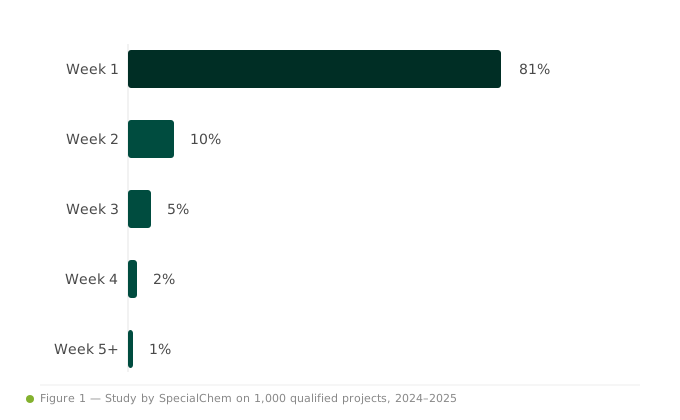
SpecialChem 2024-2025 study shows that your project discovery rate is close to 70% when you qualify inquiries in the first 24 hours. Project discovery rate drops to 10% if you reach out to the contact with a 2-week delay.
Who should be assigned project identification?
Should your sales team be tasked with it? Likely not. They are best allocated to confirmed opportunities.
Still, you need to detect which inquiry is a confirmed opportunity. Let’s remember that two sample requests may not have the same business potential, yet they look identical in your CRM. This is where project identification matters. You need someone to pick up the phone to ask the right questions: why the material specifier is looking for a material, what his technical requirements are, what volume is at stake, what the project timeframe is, etc.
Rapid qualification requires a dedicated layer that operates at inquiry speed.
|
What is Project Identification? |
|
Project Identification is a structured inside-sales qualification layer focused on one objective: determining which leads are currently engaged in an active material selection project. It operates before sales engagement and collects information such as technical requirements, projected volume, and timeframe. |
By how much can you improve your sales pipeline?
We ran a study on 8597 marketing leads. Material suppliers followed up on these leads in line with industry standards. We followed up on the same leads with SpecialChem's best practices.
The SpecialChem qualification team identified 5 times more projects. It means that with the same demand generation feeding your pipeline, you can hand over 5 times as many confirmed opportunities to your sales team. 
Sales Pipeline Best Practices: Two Approaches to Early-Stage Qualification
The difference between conventional lead handling and structured project identification is not a matter of effort or team size. Adopting a structured and systematic approach is what matters.
|
Dimension |
Conventional Lead Handling |
Structured Project Identification |
|
Follow-up timing |
5–15 days post-submission |
Within 24 hours of inquiry |
|
Qualification layer |
None - sales handles all inquiries |
Dedicated inside sales pre-qualification |
|
Project visibility |
Active projects blend with general interest |
Active projects surfaced and documented |
|
Sample confirmation |
Unverified - intent unclear |
Verified formulation context before sampling |
|
Sales focus |
Distributed across full inquiry base |
Allocated to confirmed project contacts |
|
Time to pipeline clarity |
Varies - often weeks |
24–48 hours from inquiry |
Increasing lead volume is not the only path to pipeline growth. Structured qualification of your existing inquiry base can generate more confirmed opportunities from the same demand.
Internal qualification capacity takes time to build
Many commercial teams at material suppliers evaluate the option of building internal qualification capacity. This is a legitimate path. A well-structured inside sales function can become a durable competitive asset.
The practical constraint is your timeline. Building internal qualification capacity to achieve consistent performance typically involves recruiting professionals with the right industry expertise, designing qualification processes tailored to your specific segments, and conducting a calibration period. Teams and companies that have done this have reported that reaching consistent qualification performance takes between 18 and 36 months.
During that period, the inquiry base continues generating contacts, some of which represent active projects that go unidentified.
| Complementary, not competing |
| Starting in hybrid mode, where you combine external qualification services while developing your internal capacity, allows you to build the business case while learning qualification best practices. Your internal team can progressively take over and then operate independently. |
Project Identification: what it delivers to your sales team
When SpecialChem's Project Identification service is active on your account, your commercial team receives structured output at the qualification stage.
In practice, that means:
The deliverable is a cleaner pipeline. It is designed for teams where sales time is a finite resource and where qualification speed directly affects how many active projects become visible before a material selection decision is made.
More business potential is already in your inquiry base
The bottleneck in most specialty material sales pipelines begins before the sales conversion stage. The qualification stage, specifically the 24-to-72-hour window after an inquiry is submitted, has a significant impact on the overall sales pipeline efficiency.
You may not need more leads to close more deals. Seven out of ten formulators, engineers, and product developers visiting the platform are working on an active project. Connecting with them within the qualification window is what converts that intent into a commercial conversation.
Is Project Identification right for your team?
Many material suppliers find that their SpecialChem inquiry base already contains significantly more active projects than they currently detect. Book a conversation with the SpecialChem team to evaluate what a structured qualification could reveal in your segment. |